1. Master Builders Australia Forecast: The 262,000 Dwelling Deficit Explained
Australia's acute housing supply crisis has reached a critical juncture. The Federal Government's ambitious National Housing Accord, established to construct 1.2 million new, well-located homes across the five-year period from 1 July 2024 to 30 June 2029, requires an annual completion run-rate of 240,000 new dwellings per year.
However, the latest industry econometric modeling released by Master Builders Australia (MBA) and broadcast nationally on 9 News paints a sobering picture for prospective home buyers, property investors, and mortgage holders. National dwelling commencements are forecast to fall dramatically short of official policy targets in every single financial year of the Accord.
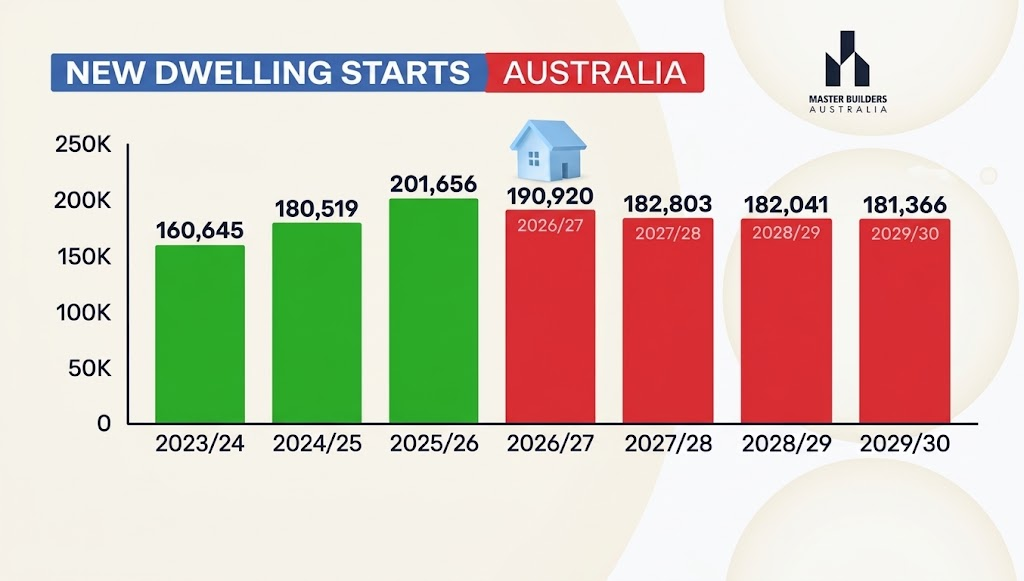
Figure 1: Australian New Dwelling Starts Forecast (2023/24 – 2029/30). Source: Master Builders Australia & 9 News.
According to Master Builders Australia's projection data, after climbing from a cyclical trough of 160,645 starts in 2023/24 to 180,519 in 2024/25, dwelling commencements are anticipated to peak at just 201,656 in 2025/26. From 2026/27 onwards, building activity drops back below the 200,000 threshold—dropping to 190,920 in 2026/27, 182,803 in 2027/28, 182,041 in 2028/29, and slipping further to 181,366 by 2029/30.
| Financial Year | Accord Target Starts | MBA Forecast Starts | Annual Deficit | Cumulative Accord Shortfall |
|---|---|---|---|---|
| 2024 / 25 | 240,000 | 180,519 | -59,481 (-24.8%) | -59,481 homes |
| 2025 / 26 | 240,000 | 201,656 (Peak) | -38,344 (-16.0%) | -97,825 homes |
| 2026 / 27 | 240,000 | 190,920 | -49,080 (-20.5%) | -146,905 homes |
| 2027 / 28 | 240,000 | 182,803 | -57,197 (-23.8%) | -204,102 homes |
| 2028 / 29 | 240,000 | 182,041 | -57,959 (-24.1%) | -262,061 homes |
| 5-Year Accord Total | 1,200,000 | 937,939 | -262,061 (-21.8%) | Shortfall: 262,061 Dwellings |
| 2029 / 30 (Out-Year) | 240,000 (Run-Rate) | 181,366 | -58,634 (-24.4%) | 6-Year Cumulative Deficit: -320,695 |
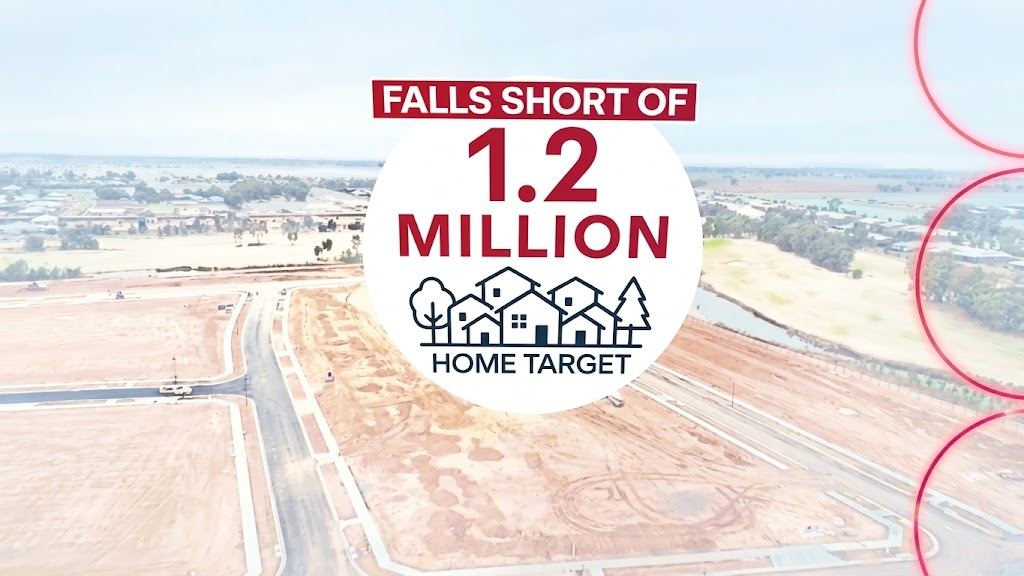
Figure 2: National Housing Accord: Commencements trail Federal Government expectations by over 262,000 homes. Source: Master Builders Australia & 9 News.
Over the official five-year Accord timeframe (2024/25 to 2028/29), Australia will construct approximately 937,939 dwellings against the 1,200,000 target—leaving a staggering cumulative shortfall of 262,061 homes (-21.8%). In practical terms, this means Australia is missing more than an entire year's worth of required building volume, compounding an already strained residential market.
2. The Triad of Structural Bottlenecks Choking Construction Commencements
Why is the construction industry unable to achieve the 240,000 annual dwelling starts required? As accredited mortgage brokers working daily with developers, head contractors, and residential borrowers, we observe three interconnected systemic bottlenecks:
- Elevated Cost of Capital & Builder Balance Sheet Scarring: With the RBA cash rate sitting at 4.35%, commercial construction finance facilities for developers range between 8.75% and 11.00% per annum. High holding debt significantly erodes developer feasibility margins. Furthermore, following more than 2,800 Australian construction company insolvencies across 2023–2025, surviving Tier-2 and Tier-3 residential builders are operating under stringent defensive balance sheets. Builders are no longer competing aggressively on thin margins; they require 15% to 20% gross project margins before executing fixed-price contracts, curbing the volume of shovel-ready sites entering the market.
- Severe Trade Shortages & Sticky Construction Labor Inflation: While raw material supply chain disruptions (timber, steel) have stabilized from post-pandemic peaks, skilled site labor remains critically scarce. Certified bricklayers, carpenters, licensed electricians, and master plumbers command top contractor rates. Furthermore, major public transport infrastructure projects across Victoria (e.g. Melbourne's Suburban Rail Loop, West Gate Tunnel Project) actively absorb civil and heavy trade labor, leaving residential builders struggling with extended site timelines. The average detached single-family home in Melbourne that previously took 6 to 8 months to build now frequently requires 12 to 16+ months from slab pour to occupancy certificate.
- Planning Friction, Statutory Council Levies & Victorian Land Tax Adjustments: Prolonged council approval pipelines and steep Section 94 development contributions continue to inflate the per-lot delivery cost of greenfield land. In Victoria specifically, recent state property tax adjustments—including lowering the general land tax threshold from $300,000 down to $50,000 alongside absentee owner surcharges—have prompted private mum-and-dad property investors to retreat from off-the-plan medium-density townhouse and apartment projects. Without private investor presales, developers cannot achieve the 60% to 70% debt-coverage covenants required by Australian commercial banks to release construction debt.
3. What Constrained Dwelling Starts Mean for Home Buyers & Investors
For everyday Australian home buyers and property investors, Master Builders Australia's forecast confirms an unavoidable economic reality: a chronic shortage of new supply creates a durable, non-negotiable price floor under established real estate.
The Mechanical Supply Squeeze
According to Australian Bureau of Statistics (ABS) demographic releases, annual net overseas migration and natural population expansion, coupled with declining average household sizes (moving from 2.59 down to 2.50 persons per household), generates underlying structural demand for approximately 220,000 to 240,000 dwellings per year. When actual commencements average only ~187,000 per year, demand perpetually exceeds net physical additions.
Suburban Corridor Performance Across Melbourne
This persistent supply deficit will not impact all property segments equally. Based on lending data across our client portfolio, we anticipate distinct suburban corridor patterns across Greater Melbourne:
- Western Growth Corridor (Point Cook, Tarneit, Werribee, Truganina, Manor Lakes): Sub-$750,000 master-planned estates face sustained demand from first home buyers utilizing the Federal 5% Home Guarantee Scheme (HGS) and Victorian First Home Owner Grant ($10,000 for new builds). Because developer land releases are bottlenecked by infrastructure rollouts, titled land parcels continue to attract premium demand.
- Northern Growth Corridor (Craigieburn, Mickleham, Wollert, South Morang): Established 4-bedroom family detached homes are commanding strong buyer attention as buyers shift away from the uncertainties of long build times toward turnkey ready-to-move-in properties.
- Middle-Ring Eastern & Bayside Corridors (Box Hill, Ringwood, Cheltenham, Moorabbin): The severe deficit in new multi-unit developments and townhouses means downsizers and young professional couples must compete fiercely for established villas and units, underpinning capital appreciation.
Rental Market Compounding & Yield Resiliency
With fewer new apartments and houses completing construction, capital city residential vacancy rates are projected to remain compressed below 1.5%. For tenants, rising rental costs make deposit accumulation challenging, increasing the urgency of accessing low-deposit schemes. For property investors, tight vacancy rates deliver reliable gross rental yields (typically 4.3%–5.5% on units, 3.6%–4.3% on detached houses) and high tenant retention rates.
4. Construction Loans vs Established Home Purchases: Financial Stress Test
When supply shortages drive up the cost of building, borrowers face a fundamental strategic question: Is it better to purchase titled land and build new, or buy an existing established property? Below, our brokerage models a comprehensive $850,000 financial scenario comparing a New House & Land Build against an Established Home Purchase in Greater Melbourne.
| Financial Assessment Metric | Option A: Build New ($400k Land + $450k Build) | Option B: Established Home ($850k Purchase) | Broker Advantage & Analysis |
|---|---|---|---|
| Purchase Price / Total Asset Value | $850,000 ($400,000 Land + $450,000 Build) | $850,000 Total Purchase Price | Equal headline valuation asset |
| Victorian Transfer Stamp Duty | ~$16,070 (Duty payable on land only) | ~$45,070 (Full property duty) | Build saves ~$29,000 in upfront stamp duty |
| Construction Holding Interest (12 Mo.) | ~$14,850 (Progressive drawdowns @ 6.00%) | $0 (Standard P&I begins immediately) | Established avoids multi-stage holding costs |
| Dual Accommodation / Rental Cost During Build | ~$33,800 (52 weeks rent @ $650/week) | $0 (Immediate move-in upon 30/60-day settlement) | Established saves $33,800+ in rent while waiting |
| Contract Variation & Price Escalation Risk | Moderate: Site costs, rock removal, prime cost items | Zero: Fixed legal contract of sale | Established eliminates builder insolvency risk |
| Bank Completion Valuation Risk | Bank conducts "As-If-Complete" valuation; risk of shortfall at handover | Upfront bank valuation confirms purchase price prior to unconditional exchange | Established provides 100% lending certainty |
| Net Financial Friction Comparison | Total Upfront Friction: ~$64,720 (Duty + Rent + Holding Interest) | Total Upfront Friction: ~$45,070 (Stamp duty only) | Established home provides ~$19,650 cash advantage |
As demonstrated in our stress test, while building a new home saves approximately $29,000 in upfront stamp duty in Victoria, the combined holding interest and 12 to 14 months of ongoing rental costs while waiting for completion total ~$48,650. This creates net holding friction that often neutralizes the initial stamp duty benefit. Borrowers must weigh the emotional and tax benefits of a brand-new home against the certainty, immediate occupancy, and fixed cost profile of an established dwelling.
5. Principal Broker Action Plan: Strategic Guidance for Borrowers
Given that dwelling completions will remain restricted through 2030, how should Australian property buyers and mortgage holders position themselves? Here is the exact strategic advisory framework we implement for clients at EZ Mortgage Broker:
1. First Home Buyers: Avoid the "Waiting for Rate Cuts" Trap
Many aspiring buyers delay purchasing in the hope that RBA cash rate cuts will improve their borrowing power. However, in an under-supplied market, interest rate reductions act as an immediate market accelerant. A 0.50% reduction in mortgage rates increases borrowing power across all market participants simultaneously, driving up median house prices by 5% to 8% within months. First home buyers should focus on entering the market as early as feasible using government assistance programs like the 5% Home Guarantee Scheme (HGS)—which waives tens of thousands in Lenders Mortgage Insurance (LMI)—before property values escalate past regional price caps.
2. Existing Homeowners: Unlock Usable Equity for Strategic Renovation
Because new construction starts are stalling and established homes are scarce, existing homeowners who need more living space should strongly consider renovating or extending their existing property rather than selling and re-buying. Selling an $850,000 home and purchasing a $1.2 million home incurs over $70,000 in selling agent commissions, marketing, and stamp duty. In contrast, conducting an equity cash-out refinance up to the 80% LVR ceiling allows you to fund an architecturally designed extension without paying government transfer duties or losing your established neighborhood location.
3. Property Investors: Focus on Land-Rich Assets Over Off-The-Plan High-Rise
With dwelling starts constrained, standalone houses with substantial land component in outer-growth corridors (such as Werribee, Tarneit, Craigieburn, and Wollert) will capture the lion's share of long-term capital growth due to land scarcity. In contrast, high-density off-the-plan apartments carry higher body corporate levies, elevated vacancy turnover, and vulnerability to bank valuation shortfalls at settlement.
4. Construction Loan Due Diligence: 5 Mandatory Broker Safeguards
If you choose to proceed with a residential building contract, ensure your broker conducts these five protective checks before loan unconditional approval:
- Domestic Building Insurance (DBI) Verification: Confirm your builder has active DBI cover registered with the Victorian Building Authority (VBA) protecting against insolvency, death, or structural defect abandonment.
- Strict Fixed-Price Clauses: Ensure the HIA or Master Builders contract has no uncapped price escalation clauses tied to CPI or material supplier costs.
- Compliant Progress Drawdown Stages: Ensure the progress claim schedule strictly mirrors the Domestic Building Contracts Act 1995: Deposit (5%), Base (10%), Frame (15%), Lock-Up (35%), Fixing (20%), and Practical Completion (15%). Never authorize out-of-sequence payments.
- Dedicated Contingency Buffer: Maintain at least a 5% to 10% liquid cash buffer outside your mortgage facility to absorb unexpected site excavation costs or rock removal without halting progress.
- Pre-Handover Independent Inspection: Engage a registered private building surveyor to conduct stage-by-stage inspections before releasing final handover funds to the builder.
Model Your Scenarios & Borrowing Power
Access our free interactive calculators and compare loan policies across 30+ Australian lenders.
Next Step in Your Journey:
Explore Home Buying & Construction Loans with an MFAA Accredited Broker →
Compare interest rates, lender assessment criteria, and turnaround speeds customized to your situation.